
What has upswings and downturns, troughs, peaks, and plateaus? Though such terms could easily describe a roller coaster ride, they are also commonly used to describe the business cycle.
The business cycle – also known as the economic cycle – refers to fluctuations in economic activity over several months or years. Tracking the cycle helps professionals forecast the direction of the economy. The National Bureau of Economic Research makes official declarations about the economic cycle based on specific factors, including the growth of the gross domestic product, household income, and employment rates.
Recovery & Recession

An upswing, or recovery, occurs when the economic indicators improve over time. A recession occurs when the same indicators go through a contraction. A particularly long or severe recession is referred to as a depression.
Despite being called a cycle, it’s important to understand that the business cycle is not regular or even cyclical. Its pattern resembles the movement of waves, and those waves don’t consistently undulate at set, periodic intervals. Some recoveries have lasted several years, while others are measured in months. Recessions, too, can last for a number of years or be as short as a few months.
Moving in Waves
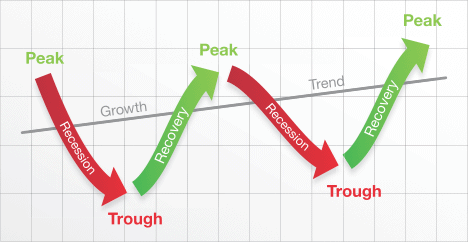
Stages of Cycle
So, how should investors look at information about the business cycle?
Investors who understand that the economy moves through periods of recovery and recession may have a better perspective on the overall cycle. During recovery, understanding whether the economy is at an early or late stage of the cycle may influence certain investment decisions. Conversely, during a recession, deciphering whether the economy is passing through a shallow or deep cycle may be influential as well.
The business cycle will transition from recovery to recession – and recession to recovery – over several months. Understanding that the economy travels through cycles may help you put current business conditions in better perspective.
The content is developed from sources believed to be providing accurate information. The information in this material is not intended as tax or legal advice. It may not be used for the purpose of avoiding any federal tax penalties. Please consult legal or tax professionals for specific information regarding your individual situation. This material was developed and produced by FMG Suite to provide information on a topic that may be of interest. FMG Suite is not affiliated with the named broker-dealer, state- or SEC-registered investment advisory firm. The opinions expressed and material provided are for general information, and should not be considered a solicitation for the purchase or sale of any security. Copyright FMG Suite.