

Rolling Treasuries: Squeezing Extra Cash Out of Cash

In a volatile market, many investors prefer to hold a little more cash than they otherwise would or make investments a bit slower – spreading out the allocation to minimize any adverse impact from sudden market drops. With cash on the sidelines earning little to nothing in return, we’ve started implementing a rolling Treasury strategy with minimal interest rate risk, no credit risk, and a current yield in excess of 2.5%, which could be better or worse depending on the timing of the process.

Here’s how it works:

Excess cash that is not earmarked to be deployed in the short-term is invested in a series of Treasury bills, maturing about one month apart from each other. The initial investment is made in Treasuries maturing in 1,2, and 3 months, with an equal allocation to each. When the first Treasury expires in one month, we roll the proceeds into another Treasury that expires three months forward, reestablishing the 1,2, and 3 month maturity schedule set at the outset.

Although this is an active management service, because of the nature of the instruments and the standardization of the process, we charge a discounted fee to implement this strategy. However, we do have a minimum requirement of $300K. Anything less becomes cost prohibitive.

Here is an example of a recent transaction:
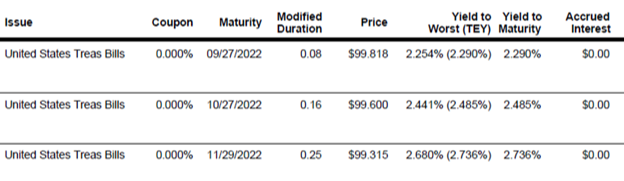
We will invest 1/3rd of the total cash into each of the above referenced T-bills. Note that the price of each T-Bill above is below 100 and the stated coupon is zero – implying that the stated yield to maturity is essentially the difference between the price paid and the amount received at maturity. The average yield to maturity of this entire transaction is 2.503%.

When the September T-Bill matures, we reinvest the proceeds into a T-bill maturing in late December if the choice is to continue to roll Treasuries. At the time of this writing, the December T-Bill was yielding roughly 2.9% with a maturity on December 29th. As rates rise, the yield on subsequent investments should continue to increase. An attractive alternative to sitting in cash while waiting to invest.

We caution investors to make sure this cash is not intended to be used within the 3-month period being considered. In the event any of the positions have to be sold before maturity, the price received would be determined by market pricing and may not result in the yield expected.

Benefits

  • Higher return than that being paid by banks on savings accounts or CD’s, and higher than the yield on money market investments.
  • Discounted management fee
  • No credit risk
  • Exempt from state and local taxes

Risks

  • Prices can still fluctuate from purchase to maturity
  • Interest rate risk – rapid rise in short-term rates could lead to missed opportunity cost.
  • Opportunity cost of potential returns in equities or higher yielding fixed income

If you have some cash lying idle not generating a decent return while you wait to deploy that capital, why not squeeze out a few extra percentage points above what a bank CD or savings account is currently paying? We can essentially lock in the yield at the time we make the investment for each security – unless of course the US government defaults.


More posts

5 Questions to Revisit Every New Year if You’re Within 5–10 Years of Retiring

Use the start of each year to reevaluate whether your retirement timing, income needs, investments, taxes, and lifestyle remain aligned with your evolving situation. Revisiting these five key questions in the final decade before leaving work can help you stay aware of potential adjustments and more intentional about how you approach the next chapter.
Retirement-Contribution-Limit-Changes

An Overview of the 2026 Retirement Contribution Limit Changes

The IRS has announced higher retirement account contribution limits for 2026, giving savers more flexibility to plan for the future. Learn about the updated limits for 401(k), IRA, SIMPLE, and SEP plans, and how catch-up contributions for individuals age 50 and older have increased. Understanding these updates can help you evaluate your current strategy and make informed decisions about your long-term retirement goals.
Retirement

Why the First Five Years of Retirement Matter More Than the Last Twenty

Early retirement decisions have an outsized impact on long-term financial success, especially for Oil & Gas professionals. The first few years set spending patterns, tax strategies, and investment outcomes that shape future stability. Thoughtful planning around income, withdrawals, and market risk can help create a smoother, more confident transition into lasting retirement.
Education planning

Education Planning: Funding Your Children’s Future Without Sacrificing Your Retirement

Business insurance planning

Business Insurance Planning: Building Financial Security for Your Company

Business insurance planning helps identify key risks, match them with appropriate coverage, and connect that protection to long‑term business and personal financial goals. By regularly reviewing policies and addressing operational, liability, cyber, and people‑related exposures, owners keep their businesses better prepared for unexpected events.
withdrawal-strategies

How Withdrawal Strategies Can Help Reduce Taxes in Retirement

Most people focus on saving for retirement but overlook how withdrawals impact taxes. Each account—tax-free, tax-deferred, and taxable—is treated differently, and coordinating them strategically can minimize taxes and smooth income over time. Smart withdrawal planning isn’t about avoiding taxes but managing when and how you pay them for better long-term control.

Paint-by-Numbers: Q4 Market Commentary

A historic U.S. government shutdown created major gaps in official economic data, forcing investors to lean on private indicators and earnings reports to judge the economy. The result was an uneasy mix of solid headline growth and very weak consumer sentiment, with clear signs that higher- and lower-income households are experiencing very different conditions. Markets stayed volatile as Federal Reserve officials split over rate cuts and as heavy, debt-fueled investment in artificial intelligence raised questions about long‑term profitability and financial risk
Estate Planning Strategies for the the End of the Year

Year-end Estate Planning Strategies

Year-end is the ideal time to review your estate plan and ensure your wishes, finances, and family priorities are protected. A thoughtful plan provides clarity, control, and peace of mind for the future. Schedule an estate plan review today to start the new year with confidence.