
Rolling Treasuries: Squeezing Extra Cash Out of Cash

In a volatile market, many investors prefer to hold a little more cash than they otherwise would or make investments a bit slower – spreading out the allocation to minimize any adverse impact from sudden market drops. With cash on the sidelines earning little to nothing in return, we’ve started implementing a rolling Treasury strategy with minimal interest rate risk, no credit risk, and a current yield in excess of 2.5%, which could be better or worse depending on the timing of the process.

Here’s how it works:

Excess cash that is not earmarked to be deployed in the short-term is invested in a series of Treasury bills, maturing about one month apart from each other. The initial investment is made in Treasuries maturing in 1,2, and 3 months, with an equal allocation to each. When the first Treasury expires in one month, we roll the proceeds into another Treasury that expires three months forward, reestablishing the 1,2, and 3 month maturity schedule set at the outset.

Although this is an active management service, because of the nature of the instruments and the standardization of the process, we charge a discounted fee to implement this strategy. However, we do have a minimum requirement of $300K. Anything less becomes cost prohibitive.

Here is an example of a recent transaction:
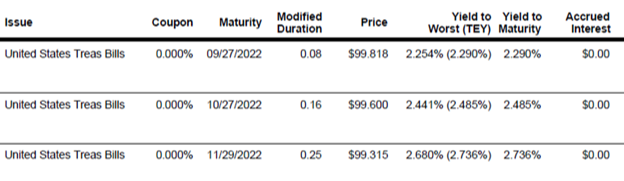
We will invest 1/3rd of the total cash into each of the above referenced T-bills. Note that the price of each T-Bill above is below 100 and the stated coupon is zero – implying that the stated yield to maturity is essentially the difference between the price paid and the amount received at maturity. The average yield to maturity of this entire transaction is 2.503%.

When the September T-Bill matures, we reinvest the proceeds into a T-bill maturing in late December if the choice is to continue to roll Treasuries. At the time of this writing, the December T-Bill was yielding roughly 2.9% with a maturity on December 29th. As rates rise, the yield on subsequent investments should continue to increase. An attractive alternative to sitting in cash while waiting to invest.

We caution investors to make sure this cash is not intended to be used within the 3-month period being considered. In the event any of the positions have to be sold before maturity, the price received would be determined by market pricing and may not result in the yield expected.

Benefits

  • Higher return than that being paid by banks on savings accounts or CD’s, and higher than the yield on money market investments.
  • Discounted management fee
  • No credit risk
  • Exempt from state and local taxes

Risks

  • Prices can still fluctuate from purchase to maturity
  • Interest rate risk – rapid rise in short-term rates could lead to missed opportunity cost.
  • Opportunity cost of potential returns in equities or higher yielding fixed income

If you have some cash lying idle not generating a decent return while you wait to deploy that capital, why not squeeze out a few extra percentage points above what a bank CD or savings account is currently paying? We can essentially lock in the yield at the time we make the investment for each security – unless of course the US government defaults.


More posts

The Overlooked Part of Estate Planning

The Part of Estate Planning No One Talks About

Estate planning extends beyond wills and inheritances. It involves preparing for everyday financial decisions, organizing key documents, and ensuring someone can step in when needed—all especially relevant for Oil & Gas professionals managing multiple accounts, benefits, and assets.
Charitable Giving Strategies for Financial Planning

Charitable Giving Strategies to Boost Your Financial Plan

Strategic, tax-smart generosity lets you support causes you care about while also strengthening your long-term financial plan. By choosing efficient methods such as bunching donations, using retirement accounts, and giving appreciated investments, you can often reduce taxes, manage portfolio risk, and build a lasting legacy without increasing your out-of-pocket cost.

Thanksgiving Reflections: Setting Yourself Up for a Stronger Financial Future

Year-end is a valuable time to reflect with gratitude and make clear, confident financial decisions. A brief review of taxes, retirement strategy, and investments in November can uncover savings, reduce stress, and set up a stronger year ahead, especially for those in the Oil & Gas industry.

Trick or Treat: Q3 Market Commentary

U.S. stocks rose in October 2025, led by strong earnings and a Fed rate cut, while the government shutdown delayed key economic data. Inflation held at 3%, labor market softened gradually, and tech giants boosted AI investments. Trade deals with Japan and China eased tensions, gold set new highs, and consumer spending stayed resilient, supporting continued market strength despite risks.
Saving vs Investing Guide

Saving vs Investing: Finding the Right Balance for Your Financial Future

Building a strong financial foundation starts with balancing saving and investing. Saving offers security and flexibility for short-term needs, while investing helps your money grow for long-term goals. Combining both creates stability today and opportunity for tomorrow.
retiring-from-big-oil

Retiring from Big Oil: What Comes Next?

Retiring from a career in Oil & Gas often means navigating unique financial complexities and redefining personal goals for the years ahead. From handling pensions, company stock, and diverse retirement accounts to crafting a sustainable income plan and addressing tax and healthcare costs, every step shapes your long-term security. By reassessing investment strategies, managing concentrated assets, and considering a second opinion, professionals can move toward retirement with greater clarity and confidence.
financial-literacy

The Power of Financial Literacy: Building a Confident Financial Future

Financial literacy is about making smart decisions that support financial stability and freedom. Early education and consistent saving help build strong habits for the future. Understanding and regularly reviewing investments, seeking professional guidance, and involving family all contribute to long-term financial well-being.

The House at the End of Retirement Road

A quiet evening turns unsettling as a storm rolls in, bringing with it memories of lost financial accounts and the growing impact of inflation. Forgotten benefits and neglected deadlines rise to the surface, serving as reminders of how easily financial security can erode through uncertainty and delays. Facing these hidden risks and seeking clarity becomes the key to transforming unease into peace of mind, letting doubts fade away in favor of a clearer future .